










Archive for the 'Financial Wellness' Category

Page 2 of 4

GuideSpark Financial Wellness Webinar

On December 8, GuideSpark presented a webinar called “The Need for Financial Wellness”.  In this webinar we discussed how poor financial health is affecting companies and their employees.  The webinar was well attended and definitely shows that financial wellness is becoming an important  issue at corporations across America.  In fact, the following poll shows that most attendees believed that 26-50% of employees are being negatively affected by financial issues.

Financial Wellness Poll Results

These results are not surprising based on our experience.  Financial issues are a productivity drain for corporations and is something we believe companies will begin to address in the coming years.  If you missed the webinar, please let us know and we’ll let you know when we have our next one.

Financial Adrenaline

What motivates someone to change their financial behavior? For example, can someone who is prone to spend every dime really be turned into a saver?

Fear can certainly be a motivator. For some it takes a tangible, in your face type fear like “I will lose my car if I can’t make the balloon payment that’s due in three months”. The force behind saving to avoid losing your wheels can be powerful.  But when the pain goes so away, often so does the temporary positive behavior. But still, something kicked in that worked.  I call this phenomenon, “adrenaline induced” financial behavior change.

Others are learning that adrenaline inducing techniques can work in more sustained, positive ways.

Inspired by a Harvard professor who combined the attraction of winning prize money with a savings program, a group of credit unions in Michigan created the “Save to Win” program. Members who put $25 or more into a Save to Win one-year CD are entered into a monthly “savings raffle” for prizes up to $400, plus one annual drawing for a $100,000 jackpot.

The outcome?   In a 6 month period the program attracted over $3 million in new deposits – many of which were from people who not been successful saving in the past.

Changing our financial heart rate, whether it’s a chance to lose big or win big looks like it has real possibilities. For me, longer term financial outcomes can change my heart rate if I let myself dream about something of value in vivid detail.

What financial outcome, if you really thought about it, would elevate your heart rate? If you can get really “pumped” about it, change will not be far behind.

Financial Wellness in 2010 – Open Enrollment Tips

As November fast approaches, you are likely beginning to receive important communications about Open Enrollment. If you’re like many employees, you may have already decided to just stick with your current elections – after all, they seem to have worked out well enough. This year, more than others in the past, taking a passive approach to Open Enrollment may be an expensive decision.

A confluence of events, including substantial increases in the cost of health care and tough economic times have likely resulted in significant changes to many of your benefits. It is of supreme importance that you understand these changes, how they impact your checkbook and ways to optimize your benefits. Keep in mind that without a qualified change of status, you will be locked into your elections until next year’s Open Enrollment period, so the time to focus on your benefits is NOW. Don’t be surprised by the cost provision changes after they take effect and it is too late to do something about them.

Here are 4 tips for making the most of your Open Enrollment period and cutting your health care related expenses:

  1. Get reacquainted with your health care plan options. This may be the most important and likely the most daunting task of all. While employers have largely absorbed the skyrocketing cost of health care (which again will see a double-digit year over year cost increase) you are also likely shouldering some of the burden. Understand the changes that are being introduced and how they will ultimately impact your wallet. Taking the time to dig into the cost provisions associated with your medical plan options will not only help to determine whether you’ve made the right selection, it will also help you to understand how to minimize your out-of-pocket expenses throughout the year. Many employers are introducing low premium/high deductible plans which can be a very cost-effective option for you, particularly if you are not a heavy user of your health care plan. Lastly, if your spouse or domestic partner also has a plan, you will want to incorporate his/her options into the evaluation process.
  2. Use flexible spending accounts. So, you knew this one was coming. Any respectable list of tips for Open Enrollment *MUST* have this in their top 4 and despite this widely held opinion, only about one-third of you actually take advantage of them. Using pre-tax dollars to pay for qualifying health care (including medical, dental and vision) expenses can save you significant dollars. For example, assume a married employee with an adjusted gross income of $100,000 who files jointly and accumulates $4,000 in medical expenses for the family. This employee would save just over $1,300 in Federal taxes for the year by using a Health Care Flexible Spending Account. An added and understated benefit of an FSA is that it actually helps you to plan and save for your health care expenses through convenient payroll deductions.
  3. Optimize your prescription drug benefits. This tip has more to do with saving throughout the year, rather than a decision that you’ll need to make for Open Enrollment. I mention it because it’s a great way to save money and could potentially impact your health care FSA contribution. Generic drugs are copies of brand-name drugs that have exactly the same intended use, effects, side effects, risks, safety, strength… in other words, their pharmacological effects are exactly the same as those of their brand-name counterparts. Taking a proactive approach and requesting a generic substitution for your prescription medication can cut down your copayment significantly. Use of generic drugs may also allow you to waive your deductible and avoid costs that are incurred when you use a brand name drug when a generic is available. Additionally, you may also be able to cut down on prescription copays by utilizing the mail order prescription drug benefit for maintenance medications.
  4. Take advantage of Health Wellness programs. Wellness incentives have become hugely popular. In fact, almost two out of three U.S. companies offer programs to keep employees healthy, and 66 percent of those offering programs use incentives. These incentives come in a number of forms, for instance, a credit toward your health care premiums. It may be the case that your employer is introducing a similar program in 2010, so be sure to understand wellness program features, incentives and consider participation.

Saving For College Not Adding Up Financially

Several significant trends are signaling a reset of how families plan and think about college costs. The evidence suggests that creative solutions will be required as key economic factors are conspiring to make a college degree financially more elusive.

Let’s look at the new realities of saving for higher education:

  • Trend # 1 – College costs are spiking due to reduced funding
    College costs have traditionally escalated 5%-6% per year already doubling the normal rate of inflation.  But now in many States, budget shortfalls have taken fees increases to a new level.

    California is a particularly dramatic example.  University of California Regents will soon vote on a 32% fee increase which is in addition to last year’s nearly 10% fee hike. This story is being repeated in varying degrees throughout the country. 

  • Trend #2 – Growth expectations of college savings accounts have been unrealized
    According to the Boston consulting firm Financial Research, the value of 529 college-savings accounts sank 21% last year.  For many families whose son or daughter was on the verge of starting school, this loss could easily represent a year or more of college funding.

    While the investment world may suggest that 2009’s year to date market recovery supports remaining in the market, many burned college savers are reluctant. A look at market history suggests that their hesitancy may be well founded. In the last 100 years there have never been two significant downturns as close together as the 2000-2003 tech bubble and 2008’s global meltdown. Especially for those families whose kids are already in their teens, the prospect of another near term sell-off is a chance not worth taking.

  • Trend # 3 – Parents are saving less for college
    Even before the downturn parents were struggling to save for college. A 2007 study by Sallie Mae, the country’s largest source of funds for higher education, found that parents of high school children applying for college had saved less than half of what they needed to cover the expected expenses. What’s more, one in five hadn’t saved anything at all.

    In May of this year, in another survey released by Sallie Mae, 47% of parents reported saving less or aren’t saving at all for their kids’ education due to the current economic crisis.

    While the points listed above may feel like the obstacles are growing insurmountable, there are ways to be proactive in this tough environment. And remember, while there are varying opinions of how much a college degree is worth over a career, there is little debate that it remains a solid investment.

So while a college degree may be more difficult to pay for in the future, here are some strategies to pull it off:

  • Make college planning a family affair – get grandparents and other willing extended family members in the game.  Anyone can make a contribution to a 529 Plan and rather than giving something that will end up at next year’s garage sale, have them contribute to the college account.
  • Use Conservative Asset Growth Projections and Allocations – Obviously stock market exposure is more tolerable the longer you have before your student reaches college. That being said, it may be more realistic and comfortable in today’s world to position college assets for a 6% or 7% long term return as opposed to a 9% or 10% return.
  • Manage Expectations – Young people are very resourceful if they need to be. Let your kids know in their junior high years that getting through college will be a team effort and everyone will be required to pitch in, including them. My son’s college roommate knew well in advance that his parents could only afford a total of $10,000 for college costs. By holding down a couple of jobs he graduated with an engineering degree with minimal outstanding loans and somehow seemed to have a smile on his face in the process.
  • Consider a Low Cost General Ed Track – Employers typically don’t care where a candidate started their degree, but rather where it was finished. By taking transferable community college courses before moving to the graduation school of choice, overall education costs can be significantly reduced. Among other benefits, this allows both you and your student two more years to save.

Rethinking the 401(k) Pitch

For nearly 30 years, employees have been coached that the best way to save for retirement is to take advantage of tax deferred investing, most prominently through their 401(k) plans. This strategy has always been anchored in the hope that lower tax brackets await us during our retirement years. But current economic realities are causing many in the financial community to question whether tax deferred saving remains a healthy long term strategy for employees.

When 401(k) plans were first rolled out in 1981, the income tax rates and bracket structure were very different than today.    The top federal tax rate was nearly 70% and there were 15 different income tax brackets separated by just a few thousand dollars of income (See Tax History).  Given those conditions 401(k) contributions presented a great opportunity to both avoid high current rates and reduce W-2 income in the contribution year just enough to move into a lower bracket.  So it seemed like a double win, lower taxes in the contribution year and in the future, when the Plan was accessed during retirement.

Since 1981 the sustained effects of “Reaganomics” led to a steady decline of both tax rates (highest federal bracket from 70% to 35%) and the number of brackets (from 15 to 6). During this period, with few exceptions, the US economy experienced robust economic growth.  401(k) Plans got even better as a result. To attract and retain employees, employers with healthy bottom lines began to offer generous matching incentives linked to 401(k) participation.

But the length and depth of the current recession is now changing the outlook for today’s 401(k) savers in two significant ways. First and most importantly, the government funded stimulus packages and propensity to grow overall government spending must be paid for at some point. This future “balance due” can only offset by higher taxes or a devaluing of the dollar (inflation).  The second effect of the current recession is that many companies have cut back or eliminated matching 401(k) contributions.

So the question for the employee now becomes, “if I no longer receive any company matching, and I may have to pay higher taxes on withdrawals in the future, is the 401(k) still the right way to save?”

Enter sound savings principles and the Roth 401(k) to the rescue.  Match or no match, automation and consistency are two key factors in any saving’s strategy.  401(k) plans are still great because the money is automatically deducted from every paycheck before it can get spent.  The recently introduced Roth 401(k) addresses the more daunting issue of higher taxes in the future by allowing after tax contributions now and tax free retirement withdrawals in retirement.

So rather focusing on the now suspect virtues of tax deferral, maybe it’s time to pitch the 401(k) as primarily a great way to save, period.  Wise portfolio allocations and a balanced approach between the Traditional 401(k) and the Roth 401(k) will address the constant winds of change that remain outside of the investor’s control.

The Health Wellness – Financial Wellness Connection

It’s been well documented that effective corporate health wellness programs have produced positive results for employees and employers over the past twenty years. Probably the most studied, extensive and longest running program is Johnson and Johnson’s “Live for Life”(now called the “J&J Health Wellness Program”) which was rolled out in 1979. Incredibly, due to both financial incentives and a corporate culture that actively promotes healthy behavior, 90% of J&J’s US employees have participated. And considering this includes a pool of 45,000+ employees, the statistics derived from the study are significant.

Defining that a successful health and wellness program, “…must demonstrate that they can improve the risk profile of employees as a whole, and, in particular, those employees at highest risk.”, the study found that J&J’s program has done just that.  Additionally, as I’m sure they had hoped, helping their workforce become healthier also helped J&J’s bottom line. Overall it was calculated that their Health & Wellness program saved J&J $38 million from 1995 – 1999.

When they detailed where the savings was realized, which approximated $224 per employee per year, over $70 of that figure was due a reduction in mental health visits.  Certainly, a significant portion of these mental health visits were stress related. A Yale University Study cited on the National Institute of Occupational Safety and Health(NIOSH) website found that 29% of employees “feel quite a bit or extremely stressed at work”.

Apparently the J&J health wellness program did a good job addressing stress related issues. And they probably picked up a bonus here as well. While more difficult to measure, it’s not hard to imagine that someone who is less stressed is also likely to be a more productive employee.

But there’s good reason to believe that health wellness programs alone are not dealing with the primary root causes of stress. According to a 2007 survey by the American Psychological Association 73% of the respondents cited money as a significant source of stress in their lives. And a recent WebMD article cited an AP-AOL study which revealed that “debt-related stress was 14% higher in 2008 than in 2004. Those who report high levels of debt stress suffer from a range of stress-related illnesses including ulcers, migraines, back pain, anxiety, depression, and heart attacks.”

When law enforcement officials are trying to track down criminal activity, their first step is often to “locate the money trail”.  Similarly, I’ve found that for employees, their personal money trail is the source for all kinds of self defeating, stressful behaviors. While the term “work-life balance” implies a healthy lifestyle, gaining a “money-life balance” provides a vital dimension in the process toward personal wholeness and health.

The right Financial Wellness program can help your workers achieve this vital balance, while complementing and driving enhanced returns for your existing Health Wellness initiatives.

Here’s what to look for as you consider this critical addition:

- Its best to select a provider that is not associated with a financial provider even though it may be tempting to default to your 401(k) vendor. Trusted information is paramount here.  If someone has something to gain by selling more mutual funds, there is reason to suspect the objectivity of the education.

- You’ll want a program that reaches employees in multiple ways including leveraging current web trends. New “Web 2.0” formats are being introduced to deliver financial education in engaging formats that deliver lots of information in just a few minutes.  Blended with onsite workshops and personalized, education-only money coaching, employees can interact with the information however they feel most comfortable.

- And finally, to get buy-in from other key decision makers, look for a financial wellness program that provides the methodology, metrics and reporting tools to document year over year financial health improvement. While some measures may not be as direct as the Johnson and Johnson study, measuring a reduction in personal financial stress is doable.  In fact, there is a well researched assessment tool called the “Personal Financial Wellness Score” which measures personal financial stress and compares an individual’s results to national averages.

GuideSpark Announces New Hire Training and Open Enrollment Modules

Today, GuideSpark announced two new modules for its Benefits Learning Center solution.  These modules automate and streamline New Hire Training and benefits communications for Open Enrollment.  As companies continue to prioritize doing more with less, many employers are looking for more efficient and effective ways to deal with these resource-intensive processes.

Consider for a moment the staff time and dollars go into facilitating New Hire Training and Open Enrollment each year.  Many companies we’ve met with offer half-day New Hire orientations on a near weekly basis.  Not to mention the time and effort that goes into the creation of the stacks of paper that employees receive on their first day.  Open enrollment presents a similar situation.  Each year, HR staff offer a collection of live seminars to explain benefits changes, often preceded by brochures, mailers and the like.  Despite all of this effort, nearly 80% of employers believe that their employees do not have a good understanding of their benefits.

Many employers have asked us how they free up their valuable, and in many cases shrinking HR staff to work on strategic projects while improving rates of benefits understanding among employees.  In addition, finding ways to communicate effectively has become an even higher priority as employers prepare to make difficult announcements about cutting programs and/or asking employees to take on a greater share of health care costs.

Our answers to such questions naturally start with what we know to be true about today’s employees:

  • First, given the trend of increasingly distributed workforces and the importance of family decision makers, on-site seminars fail to provide reach
  • Next, given the explosion of web multimedia and sites like YouTube, employees have become accustomed to rich, short-form content.  The busy professional of today simply does not have the attention span to thumb through lengthy benefits documents.

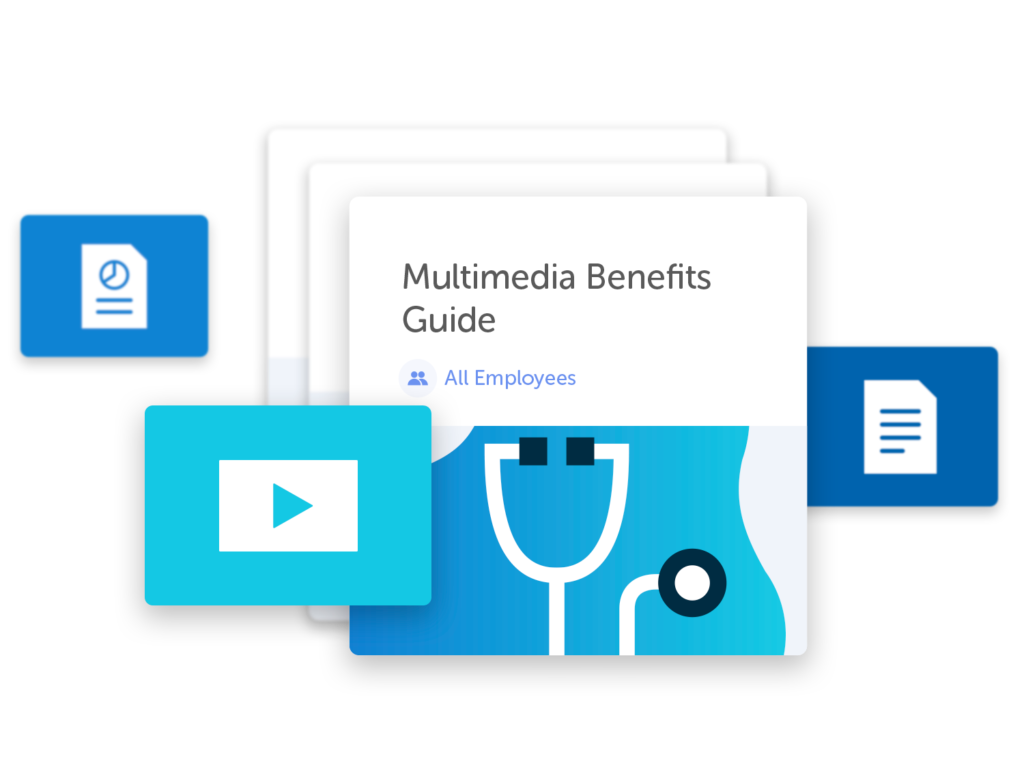
GuideSpark’s Benefits Learning Center modules embrace these trends to provide a modern and engaging multimedia solution capable of reaching your distributed workforce and their families.  This online solution automates open enrollment and new hire training workflows to free up valuable resources.  Employees have on demand access to a library of multimedia benefits presentations, allowing them to direct and personalize their learning experience.  In addition, these modules offer custom checklists for open enrollment and new hire on boarding, so that employees can conveniently track their progress.

Please take a look at the New Hire Training and Open Enrollment demonstrations on our site to better understand the power of these new modules.

The $4.5 Billion Productivity Drain – Employee Financial Distress

A recent BusinessWeek article “Helping an Employee in a Personal Financial Crisis” had a number of eye-opening estimates about the effect of financial distress on employees and employers.  The article sites the Personal Finance Employee Education Foundation estimating the cost of personal financial woes to corporations at $4.5 Billion annually and a Chicago consultant estimating a financially unstable worker can cost a company as much as $480 per month.

As a company focused on improving the financial health of employees, it’s good to see BusinessWeek covering small business examples, as it shows the depth of the problem.  While larger companies like IBM, Pepsi and Home Depot have received good press coverage over the past few years for their financial education and literacy programs, smaller companies are also taking notice and implementing programs.  I think this section from the BusinessWeek article sums it up the problem well:

As the recession grinds on, more companies find themselves managing workers facing personal financial crisis. And while employers like Humanix treat workers like family, taking care of them makes business sense as well. “I don’t want to make it Pollyanna,” says Humanix’s Nelson. “If an employee has a stressful financial situation at home, they’re not going to be fully engaged in their job.”

Raising Financially Responsible Kids Accidentally

Recently after conducting a financial education workshop for a high tech company, a young lady in her early 20’s wanted to get together to discuss how she could retire early. She had seen an infomercial that described the beauty of passive income and decided it was her ticket to an early exit.

Unfortunately, just after learning of her financial ambitions, she informed me that she had maxed out several credit cards and financed two cars (one for her boyfriend) to the tune of a significant five digit debt.  Even though she was making a good salary as a Human Resource professional, she was unable to pay her monthly bills and had stopped contributing to her 401(k).

Further, responding to the stress, she had just contracted with a credit repair outfit (another TV ad) to whom she had already paid $1,500 for services she was unclear about.  The only thing she knew was that the $1,500 somehow did not offset any of her debt.  Needless to say, it didn’t seem like passive income was going to happen anytime soon.

I wish I could say that I was a perfect dad when it came to teaching my kids about money, I wasn’t. But it looks like my three 20-something kids are avoiding the financial sabotage described above. In hindsight, I think the best idea we transferred as parents was that you don’t keep it all for yourself.  And though none of this was premeditated, the encouragement to give money away resulted in several hoped for financial behaviors and character qualities.  To name a few…

  • Although we were inconsistent about doling out an allowance, our kids figured out ways to make money and still chose to give some of that away. Seemed like it was more meaningful to give money that they had actually earned.
  • Don’ think the word “budget” was ever mentioned but  they seemed to pick up the idea on their own…they only spent what was left over after giving so they had to think more intently about financial  trade-offs early on.
  • The practice of giving apparently drew their attention to needs outside themselves, two of them have spent time working with non-profits and third world countries.

This blog entry is as close to a “raising financially responsible kids” book as you will ever get from this me.  Anything good that happened was purely by accident. But the best part is that accidents can sometimes have surprisingly decent outcomes.  And, as you probably noticed, I think my kids are cool.

As a final thought in keeping with our recent celebration of Independence Day, Thomas Jefferson spoke to the younger generation of his day regarding the wisdom of maintaining personal financial freedom…

“But I know nothing more important to inculcate into the minds of young people than the wisdom, the honor, and the blessed comfort of living within their income, to calculate in good time how much less pain will cost them the plainest stile of living which keeps them out of debt, than after a few years of splendor above their income, to have their property taken away for debt when they have a family growing up to maintain and provide for.”

Financial Wellness and Unintended Consequences

If my brother-in-law was lined up with 10 people and you were asked to pick out the economist, he would be easily identified. In the 35 years I’ve known Mitch, he has never cared a lick about the clothes he wears or the car he drives.  There is no pretense or image thing going on whatsoever.  He’s just a solid, albeit quirky guy who happens to be intellectually brilliant. And doing things his own way,  he retired early, owns a free and clear home in beautiful La Jolla, CA (my sister’s influence) and accumulated a fair amount of wealth, while never wavering from his extreme aversion to risk.

Since I’m in the financial education business, you can imagine that our conversations have touched on current economic events from time to time. He generally replies like the university professor he once was, exploring all the possible outcomes and remaining specifically non-committal. However, I was a little surprised by his very direct response to my most recent question…”What will be the most pronounced effect of the government’s stimulus package?”  “Inflation”, he replied.

While we don’t always agree, I totally concur that the recent government bailout actions will have inflation as their unintended consequence.  And if we think that a 40% market correction is bad, couldn’t a 40% devaluation of the dollar create the same effect?  The principles I learned in Econ 101 taught me that you can’t just print trillions of dollars and inject them into an economy without devaluing the underlying currency.  And it even feels more intuitively uncomfortable that we are using this “monopoly money” to buy assets that nobody else wants.

As Warren Buffet stated last month when commenting about where the bailout resources will come from, “I haven’t had my taxes raised,” said Buffet, “My guess is the ultimate price will be paid by a shrinkage of the value of the dollar.”

There are recent examples of country’s running into problems in this same way. In the early 90′s, the Yugoslavian government ran a budget deficit that was financed by printing money. This led to a rate of inflation of 15 to 25 percent per year.  The numbers actually got worse as they were dealing with other problems like socialism and rampant corruption… that are hopefully not part of our future.

Please hear me clearly, I don’t think the government should have stood idly by while the markets were imploding and institutions were failing at an alarming rate last year.  But for main street folks like you and I, it’s a good time to be thinking about measures to combat the potentially devastating effects of inflation.  Warren, Mitch and I are apparently not the only ones who are on this track. You may want to peruse this Journal article to learn more about some inflation fighting “vitamins” for your personal consumption.